
Arcade Of The Dark

Enter If you Dare


Andrew Doss
KEYBOARDS • COMPOSER • SONGWRITER
I've been making music for most of my life. I started piano lessons when I was five, and somewhere along the way music stopped being something I simply listened to and became the way I make sense of the worlds I imagine.
One of my earliest obsessions was KISS. It wasn't only the music that got me. KISS were larger-than-life characters with costumes, makeup, personalities, and their own mythology, and Gene Simmons' Demon was my favorite of the bunch. The idea that a rock band could become an entire world of characters and spectacle stuck with me and never really left.
Then came the synthesizers.
The music of the 1980s cracked everything open for me. Electronic artists showed me that a keyboard could be far more than chords behind a singer. It could build an environment. It could sound futuristic, strange, beautiful, or unsettling, and it could make you feel like you'd stepped somewhere else entirely. I've spent the decades since chasing that idea.
I've worked as a keyboardist, songwriter, composer, and recording artist, playing in bands and theatrical productions across the Southeast. I've always been drawn toward projects that blur the line between a concert and something more theatrical.
One of the strangest chapters of that journey was performing with the Transylvanian Orchestra at Six Flags Over Georgia, a production that mixed live music with costumed characters, horror, fantasy, and spectacle. The music wasn't simply accompanying the show. It was part of the world being built.
I've carried that same instinct into my own recordings. My album Unearthed: A Symphony of Madness is probably the clearest example. It's an instrumental journey inspired by the cosmic horror of H.P. Lovecraft, approached almost like a film without pictures, using synthesizers, orchestral textures, voices, and sound design to pull the listener somewhere increasingly unsettling.
I've chased similar ideas through projects where music collides with visual art, video games, and storytelling. I've never cared much about keeping those things in separate boxes. Music can be a song, a soundtrack, a character, a setting, or an invitation into a world that didn't exist five minutes ago.
That is also what drew me to Midnight Cathedral.
It's a place where music, characters, storytelling, atmosphere, and theatrical performance are all allowed to exist together. Behind the keyboards, I get to help build that world one sound at a time.
I'm still fascinated by the fact that you can walk onto a stage, touch a synthesizer, and convince a room they've stepped somewhere else.
Preferably somewhere a little darker.

GENERAL ANDREAS VOSS
THE BLACK MAESTRO

Andreas Voss was born beneath a banner that no longer exists.
His father ruled a small northern province along the mountain passes, a hard country where winter buried roads beneath snow and armies learned quickly that stone walls meant nothing if the men defending them lacked discipline.
Andreas learned warfare before he was old enough to carry a sword.
He watched soldiers drill in the courtyards below his father's keep. He studied maps by candlelight and listened silently while commanders argued over roads, rivers, food and fortifications. While other boys dreamed of glorious charges and songs written about their victories, Andreas became fascinated by what happened before the battle began.
Where men were placed.
When they moved.
Which road they were allowed to see.
And which road they were never meant to notice.
His father's kingdom eventually fell.
Not because its soldiers were weak, but because its allies abandoned them.
For eleven days Andreas fought beside the remaining defenders while enemy forces surrounded the fortress. On the twelfth night, with the outer walls broken and most of the garrison dead, Andreas ordered the surviving soldiers through an abandoned mountain passage.
He remained behind with fewer than forty men.
By sunrise, the enemy believed an entire army still occupied the fortress.
By sunset, Andreas and his remaining soldiers were gone.
The enemy entered an empty castle.
Years later, that story reached Erich von Schwarzmond.
Erich summoned Andreas to his court.
Their first meeting lasted less than an hour.
No oath was demanded.
No threat was made.
Erich placed a map upon the table and asked Andreas how he would conquer the kingdom drawn upon it.
Andreas studied the map for several minutes.
Then he moved three markers.
"Do not conquer it," he said. "Make them believe their neighbors already have."
Erich smiled.
Andreas Voss never left the Black Moon court again.
He became one of Erich's most trusted generals, commanding forces where patience mattered more than numbers. He preferred deception, divided armies, false retreats and battles decided before the first blade was drawn.
Among the soldiers of the Black Moon, he became known as the Black Maestro.
Not because he created music.
Because Andreas viewed war as something that must be arranged.
Every soldier had his place.
Every movement had its moment.
Every silence had purpose.
And when all of those pieces moved together, armies died without ever understanding the design that destroyed them.
Erich trusted very few men.
Andreas Voss was one of them.
When the great war councils gathered beneath the banners of the Black Moon, Andreas stood close enough to the war table to speak directly to his king.
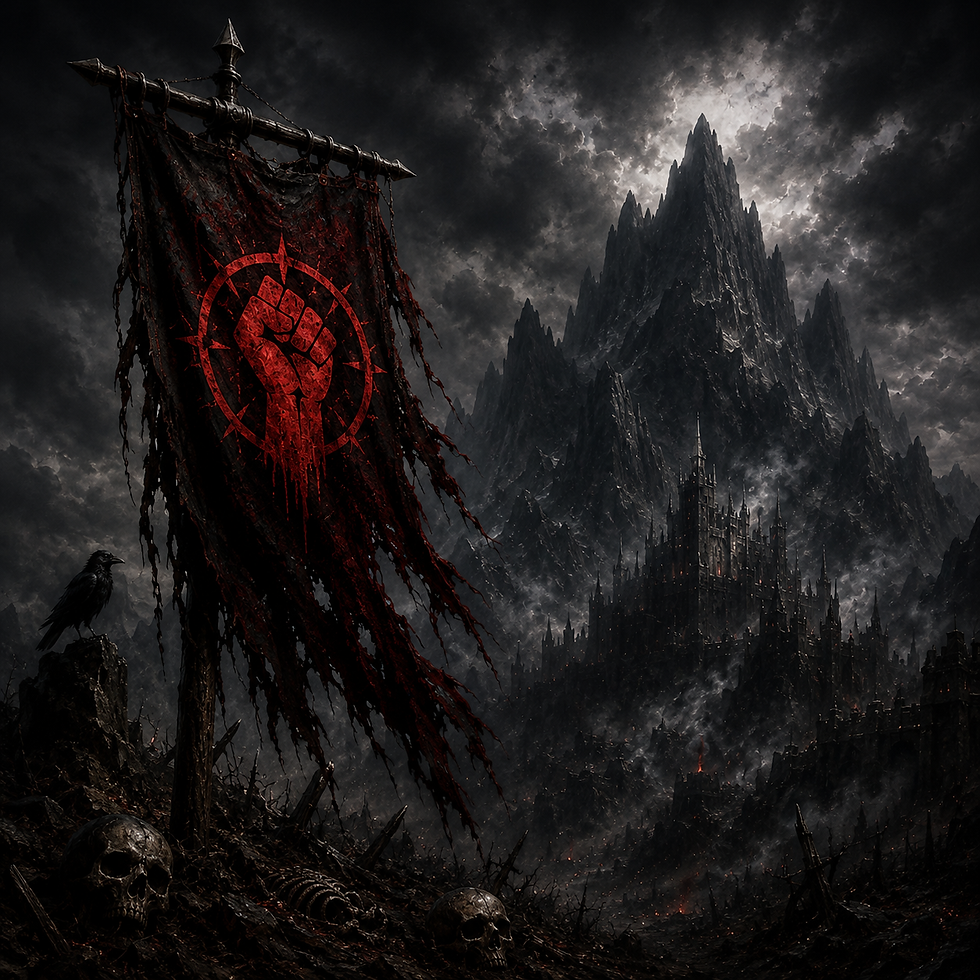
And when Erich von Schwarzmond finally turned his attention toward the Crimson Fist, Andreas was already studying the roads that led toward their walls.
He knew nothing of destiny.
He cared little for prophecy.
He believed in preparation, discipline and loyalty.
But even Andreas Voss understood one truth.
The coming war would not be like the others.
Because for the first time in his life, the Black Maestro could not see how the battle would end.